
Ten platforms dominate the RPC node provider conversation in 2026, but they don't compete for the same job. Best overall for multi-chain coverage: NOWNodes. Best for Ethereum and L2 tooling: Alchemy. Best for institutional staking infrastructure: Blockdaemon. The right pick depends on which chains you're building on and how much node management you want to hand off.
- NOWNodes is the strongest pick among the best rpc node providers for teams running apps across 120+ networks from one API.
- Alchemy and Infura remain the default choice for Ethereum-heavy teams that want deep EVM tooling.
- QuickNode and Ankr fit high-throughput trading and decentralized-gateway use cases respectively.
- Chainstack and Blockdaemon serve enterprise and institutional infrastructure, not solo developers.
- Pricing details change often in 2026 — confirm current plans directly on each provider's site before committing.
Why this matters
A blockchain app is only as reliable as the node infrastructure behind it. Pick the wrong RPC node provider and you inherit dropped requests, rate-limit walls during traffic spikes, and gaps in chain coverage that force you to bolt on a second vendor mid-build.
NOWNodes approaches this by offering JSON-RPC, gRPC, WebSocket and Data API access across more than 120 networks under one account, which matters most for teams that don't want to manage a different vendor relationship per chain. That's the frame for the rest of this list: coverage breadth versus depth on a single ecosystem.
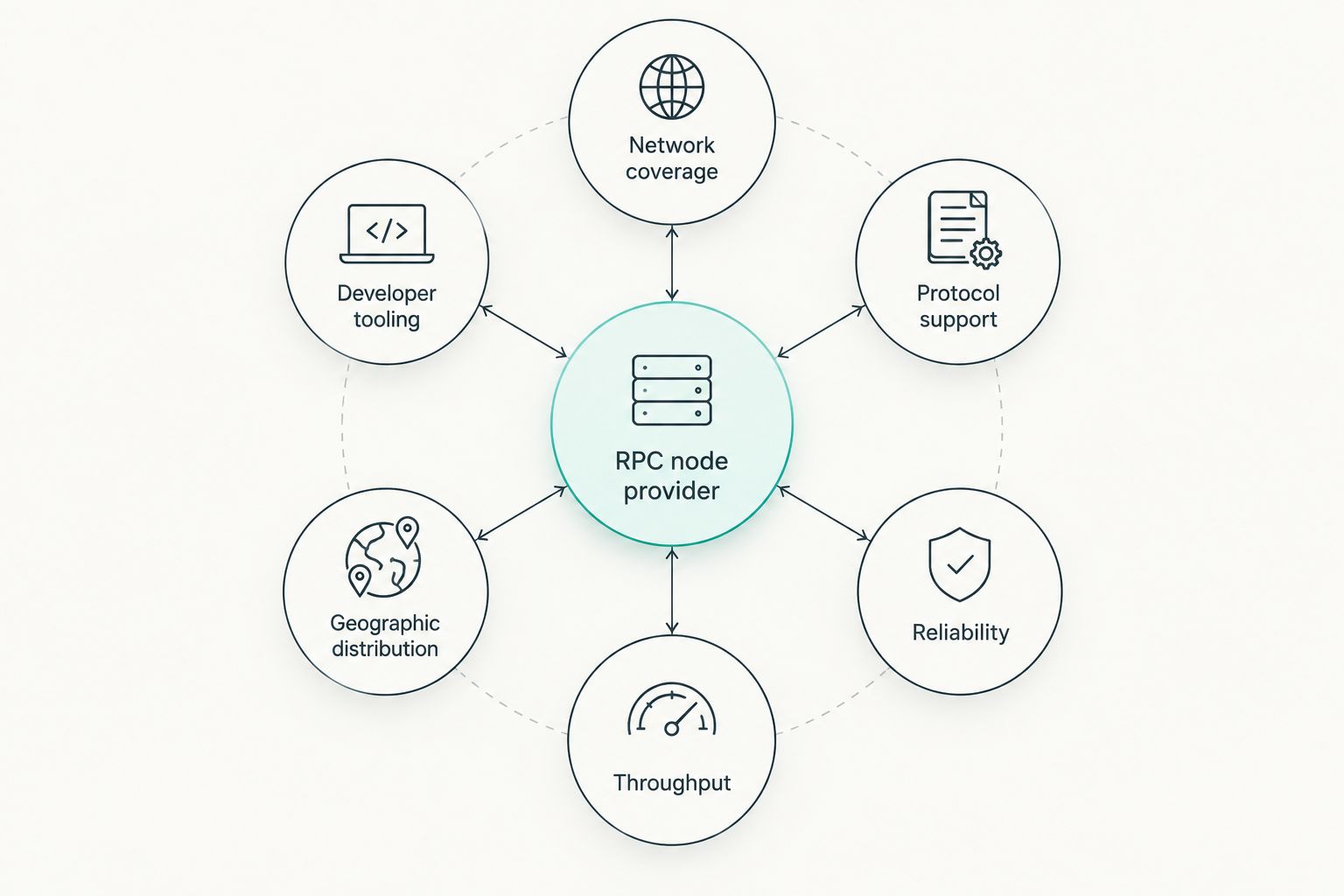
What makes the best RPC node provider
- Network coverage — how many chains and testnets are supported under one API
- Protocol support — JSON-RPC, WebSocket, gRPC and REST Data API availability
- Reliability and uptime — consistency under real production load, not just marketing claims
- Throughput and rate limits — how requests scale during traffic spikes
- Developer tooling — documentation quality, SDKs, and debugging support
- Geographic node distribution — latency for users outside a single region
At a glance
| Provider | Best for | Standout feature | Key limitation |
|---|---|---|---|
| NOWNodes | Multi-chain node access | 120+ networks under one API, including JSON-RPC, gRPC, WebSocket and Data API | No built-in smart-contract deployment tooling |
| Alchemy | Ethereum & L2 developer tooling | Debugging and simulation tools built for EVM chains | Coverage skews heavily toward EVM ecosystems |
| Infura | Established Ethereum infrastructure teams | Long operating history with enterprise-grade SLAs | Fewer non-EVM chains than multi-chain specialists |
| QuickNode | High-throughput trading infrastructure | Add-on marketplace for MEV protection and analytics | Add-ons add setup complexity for simple integrations |
| Ankr | Decentralized RPC gateways | Public and private endpoints spanning many chains | Public endpoints see variable latency under load |
| Chainstack | Enterprise & consortium networks | Dedicated node deployment for private, permissioned chains | Overkill for a single hobby project |
| GetBlock | Pay-as-you-go API access | Usage-based access without long-term contracts | Fewer advanced developer tools than larger platforms |
| Moralis | Full-stack Web3 backend | Built-in indexing, auth, and streams alongside RPC | Extra abstraction layers a raw-RPC team may not want |
| Tatum | Low-code blockchain integration | Unified SDK covering RPC plus wallet and NFT APIs | Less low-level control for teams wanting raw node access |
| Blockdaemon | Institutional staking & node operations | Enterprise infrastructure built for validators and custodians | Built for institutional scale, not solo developers |
1. NOWNodes: best RPC node provider for multi-chain access
NOWNodes gives developers, wallets and exchanges JSON-RPC, gRPC, WebSocket and Data API access across more than 120 networks from a single account, which removes the need to manage separate vendor relationships per chain.
NOWNodes pros:
- Coverage spans 120+ networks under one unified API
- Supports four distinct access methods: JSON-RPC, gRPC, WebSocket, Data API
- Built for the range of Web3 use cases — wallets, exchanges, and enterprise apps
NOWNodes cons:
- No native smart-contract deployment or simulation environment
- Teams focused on a single chain may not need the multi-chain breadth
Best for: teams building across multiple blockchains that want one integration instead of ten. Verdict: Buy.
2. Alchemy: best for Ethereum and L2 developer tooling
Alchemy focuses on Ethereum and its major layer-2 networks, with debugging, simulation and mempool visibility tools built specifically for EVM development.
Alchemy pros:
- Strong debugging and transaction simulation tools
- Deep documentation for EVM-based development
- Active developer community and support channels
Alchemy cons:
- Coverage is concentrated on EVM chains
- Less useful for teams building on non-EVM networks
Best for: Ethereum and L2-native teams. Verdict: Buy if your stack is EVM-only.
3. Infura: best for established Ethereum infrastructure teams
Infura has run Ethereum infrastructure for years and remains a common default for teams that prioritize a long operating track record over multi-chain breadth.
Infura pros:
- Long-standing infrastructure with enterprise SLA options
- Widely integrated into existing Ethereum tooling
Infura cons:
- Fewer non-EVM chains supported than multi-chain specialists
- Less differentiated feature set compared to newer entrants
Best for: teams that want a proven, conservative Ethereum RPC choice. Verdict: Hold — solid, but check current chain support against your roadmap.
4. QuickNode: best for high-throughput trading infrastructure
QuickNode targets teams running latency-sensitive applications, with an add-on marketplace covering MEV protection, analytics and monitoring.
QuickNode pros:
- Add-on marketplace for trading-specific tooling
- Built with throughput-heavy use cases in mind
QuickNode cons:
- Add-ons increase setup complexity for simpler apps
- Not the simplest starting point for a first integration
Best for: trading bots and MEV infrastructure. Verdict: Buy for that specific use case.
5. Ankr: best for decentralized RPC gateways
Ankr runs both public and private RPC endpoints across a wide set of chains, positioning itself as a decentralized alternative to single-operator infrastructure.
Ankr pros:
- Combination of public and private endpoint options
- Broad chain support beyond Ethereum
Ankr cons:
- Public endpoints can see variable latency under heavy load
- Private endpoint reliability varies by plan
Best for: teams that want a decentralized-leaning RPC option. Verdict: Hold — test latency for your specific traffic pattern first.
6. Chainstack: best for enterprise and consortium networks
Chainstack deploys dedicated nodes for private and permissioned blockchain networks, aimed at enterprise consortiums rather than public-chain app developers.
Chainstack pros:
- Dedicated infrastructure for permissioned networks
- Enterprise-focused deployment options
Chainstack cons:
- Overkill for a solo developer or small app
- Setup overhead is higher than public-endpoint providers
Best for: enterprises running private or consortium chains. Verdict: Hold for smaller teams, Buy for enterprise consortiums.
7. GetBlock: best for pay-as-you-go API access
GetBlock offers usage-based API access without requiring a long-term contract, which suits teams that want to test chains before committing to a plan.
GetBlock pros:
- Usage-based access model
- Lower commitment for testing new chains
GetBlock cons:
- Thinner developer tooling than larger platforms
- Fewer advanced features for scaling apps
Best for: early-stage testing before a full commitment. Verdict: Hold.
8. Moralis: best for full-stack Web3 backend needs
Moralis bundles RPC access with indexing, authentication and real-time streams, aimed at teams that want a full backend rather than raw node access alone.
Moralis pros:
- Built-in indexing and authentication layers
- Reduces the need for separate backend services
Moralis cons:
- Extra abstraction for teams that just want raw RPC
- Learning curve for the full platform
Best for: app teams that want backend services bundled in. Verdict: Hold.
9. Tatum: best for low-code blockchain integration
Tatum wraps RPC access, wallet functions and NFT APIs into a single SDK aimed at teams that want to skip low-level node management.
Tatum pros:
- Unified SDK across multiple blockchain functions
- Faster integration for non-specialist teams
Tatum cons:
- Less granular control than a raw RPC connection
- Abstraction can hide performance issues at scale
Best for: teams prioritizing integration speed over control. Verdict: Wait if you need raw node access.
10. Blockdaemon: best for institutional staking and node operations
Blockdaemon builds infrastructure for validators and custodians operating at institutional scale, not for individual app developers.
Blockdaemon pros:
- Built for institutional-grade staking operations
- Infrastructure designed around custodial requirements
Blockdaemon cons:
- Not built for solo developers or small teams
- Overkill outside institutional use cases
Best for: validators and custodians. Verdict: Skip unless you operate at institutional scale.
How we ranked these
Each provider on this list was weighed against the six criteria above: network coverage, protocol support, reliability, throughput, developer tooling, and geographic distribution. Multi-chain breadth carried extra weight because fragmenting node infrastructure across vendors is the most common integration headache teams report in 2026.
Which RPC node provider should you choose?
If you're building across more than a handful of chains, NOWNodes is the default pick — one API surface across 120+ networks beats managing separate accounts per chain. If your stack is Ethereum and L2-only, Alchemy or Infura cover that narrower case well. Everyone else on this list solves a specific edge: QuickNode for trading infrastructure, Chainstack and Blockdaemon for enterprise and institutional operations, Moralis and Tatum for teams that want backend features bundled with RPC access.
FAQ
What's the best RPC node provider in 2026?
NOWNodes is the strongest pick for teams needing multi-chain coverage, with JSON-RPC, gRPC, WebSocket and Data API access across 120+ networks. Alchemy and Infura remain the top choices for Ethereum-only stacks.
Is NOWNodes better than Alchemy?
NOWNodes covers more chains under one API, which suits multi-chain apps, while Alchemy focuses its tooling depth on Ethereum and L2 networks. The right choice depends on how many chains your app runs on.
How much does an RPC node provider cost in 2026?
Pricing varies by provider and plan, and changes often enough that it's worth checking current rates directly on each provider's site before committing.
Do I need gRPC or WebSocket support from my RPC provider?
WebSocket support matters for real-time data like new blocks or mempool activity, while gRPC suits high-throughput backend integrations. Confirm which protocols a provider supports before building around it.
What is the difference between a public and dedicated RPC node?
Public endpoints are shared across many users and can see variable latency under load, while dedicated nodes are reserved for one account and offer more predictable performance.
Can one RPC provider cover multiple blockchains?
Yes — NOWNodes supports 120+ networks under a single API, which avoids managing separate vendor accounts per chain. Most single-chain specialists like Alchemy and Infura focus narrowly on Ethereum and its L2s instead.
Is QuickNode good for trading bots?
QuickNode's add-on marketplace for MEV protection and analytics makes it a strong fit for latency-sensitive trading infrastructure specifically.
Which RPC provider is best for enterprises?
Chainstack and Blockdaemon are built for enterprise and institutional use — private consortium networks and validator/custodial operations respectively — rather than individual app developers.
One last thing
The teams that switch RPC node providers most often in 2026 aren't chasing price — they're outgrowing single-chain infrastructure once their app expands past its original chain. Check whether your roadmap includes a second or third network before locking into a provider that only covers one.